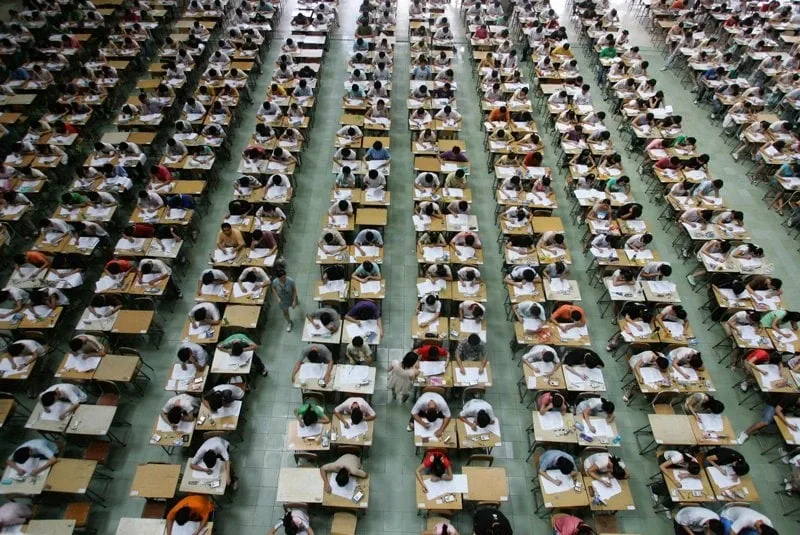
Every year, commentators and influencers reach for the same line - JEE is the Gaokao of India, the same brutal competition, just with a different flag. The comparison survives only because both exams are enormous, both decide a teenager’s entire life trajectory in a single sitting, and both have produced an industry of coaching towns, family debt, and quiet tragedy.
But the comparison rests on a category error. Look past raw selectivity, which, at the very top, actually favours China, and a more important distinction appears: the Gaokao is built to find almost everyone in the country a seat somewhere, while the JEE is built to discard almost everyone who takes it. One is a sorting mechanism, the other is a needle’s eye. And once you look past JEE to NEET, UPSC, and India’s recruitment exams generally, the same general logic repeats: not selection, but elimination.
China’s Gaokao: Beyond the Brutality
In 2023, a record number of 12.91 million students sat the Gaokao. This number climbed to a peak of 13.42 million in 2024 before dipping slightly in 2025, the first decline in eight years, as China’s shrinking youth population finally caught up with the exam.
At the very top, the Gaokao is genuinely brutal. According to data compiled by Chinese state media outlets, only about 10% of takers reach an honours degree program, just 2% land a seat at one of China’s 39 most prestigious universities, and a candidate’s odds of an undergraduate place at Tsinghua or Peking University sit at roughly 5 in 10,000 - about 0.05%. That is a far crueller number than anything the JEE produces.
But that brutal approach is not the system. Below it sits a vast, tiered structure engineered to catch almost everyone else. China’s college admission rate has climbed steadily for decades - from 55% in 1999 to 88% by 2019, and colleges and training institutions are now posting admission rates around 90%. The mechanism isn’t generosity; it’s capacity. China built enough seats across enough tiers to absorb the people that top-tier universities reject.
The strongest proof that this was designed on purpose, rather than happening by accident, can be seen at the bottom of the prestige ladder. China’s vocational colleges - once the consolation prize for students who bombed the Gaokao - are now recruiting top scorers with explicit job guarantees:
- Shenzhen Polytechnic University admitted a student with 181 points above the province’s undergraduate cutoff.
- Beijing Polytechnic University has half its student body enrolled in directed-training schemes tied to employers in smart manufacturing, new energy, and biomedicine industries.
- The Ministry of Education has approved 87 vocational bachelor institutions, with 36 added in a single year.
Job-placement rates at these vocational undergraduate colleges now outpace those of traditional universities. In other words, China is actively re-routing talent into a track that guarantees employment, rather than letting it pile up at the base of a credential pyramid with nowhere to go. The Gaokao identifies talent, and the system finds a use for it. That is the central “positive process” in the comparison.
The JEE: A Funnel with No Floor
JEE Main 2025 drew 15.39 lakh (1.54 million) registered candidates, of whom 14.75 lakh actually appeared. The top roughly 2.5 lakh of them became eligible for JEE Advanced. In 2025, 1,80,422 candidates sat JEE Advanced and 54,378 qualified, competing for a total B.Tech intake across all 23 IITs of roughly 18,000 seats.
Stack the filters, and the funnel becomes visible:
- Only 1 in 10 candidates who clear JEE Main secure any seat at all (IIT, NIT, IIIT, or a GFTI) through the JoSAA counselling process.
- Among the much smaller pool who clear JEE Advanced, only 1 in 3 actually lands an IIT seat specifically.
- The IIT seat rate against total JEE Main candidates works out to roughly 1.2%.
There is no vocational safety net wired into this system the way there is in China. Below the IITs sit more than 4,000 private engineering colleges turning out roughly 1.5 million engineering graduates a year. A 2024 industry report from staffing firm TeamLease estimated that only about 10% of that year’s graduates would actually find jobs in their field.
This is not a one-year anomaly:
- A 2019 NASSCOM survey found that of 1.5 million annual engineering graduates, only about 17% secured jobs in any core engineering industry.
- The Unstop Talent Report 2025 found that 83% of 2024’s engineering graduates remained unemployed or without even an internship, despite headline “employability” scores claiming over 70% were job-ready.
The employability test measures a score. It does not measure a job. The JEE doesn’t fail to be a Gaokao. It succeeds at being something else: a single, narrow gate with a credential glut piling up behind it.
It Isn’t Just JEE: Elimination is the Design Pattern
The same shape repeats across almost every major Indian competitive exam, which is the part of the comparison that usually gets dropped.
| Exam | Applicants | Seats/Posts | Selection Rate |
|---|---|---|---|
| NEET 2025 | 20.9 lakh appeared | 1,15,900 MBBS seats | 1 in 10 qualified |
| UPSC 2024 | 5,83,213 appeared | 1,009 appointments | 0.17% |
| Railways 2018 | 2.37 crore applied | 89,409 posts | 256 applicants/vacancy |
| UP Peon Posts 2015 | 23 lakh applied | 368 posts | 6,250 applicants/post |
The Railway and peon numbers deserve a second look. These are not elite roles - yet among 23 lakh applicants for 368 peon seats were more than 250 PhD holders and roughly two lakh engineering and science graduates. In 2018, a similar UP recruitment drive for 62 peon-messenger posts drew tens of thousands of applicants, including thousands of postgraduates and PhD holders.
None of these exams is a villain by design. They are responses to a single structural fact: there are far more credentialed people than there are credentialed-appropriate positions in a country that built its examination culture around scarcity rather than capacity.
The exam does exactly what an exam should do - it filters. The problem is that in India, the filter empties into nothing, while in China, it empties into a tiered system engineered to catch almost everyone the top rejected.
Why the Systems Actually Diverge: Capacity, Not Culture
The instinct is to explain this gap with culture - Indian families fixate on prestige, Chinese families are more pragmatic, and so on. The more useful explanation is structural:
- India’s Gross Enrollment Ratio (GER) in higher education sits around 28%, with a 2035 target of merely reaching 50%.
- China’s GER is roughly 54–60%.
- The United States’ GER sits near 88%.
The Gaokao sorts 13 million people into a system that was built, deliberately and at public expense, to hold most of them. JEE, NEET, and UPSC sort smaller pools into systems that were never built to hold them. When the underlying capacity is roughly half of China’s, an entrance exam stops functioning as a talent filter and starts functioning as a rationing device for an artificially scarce resource. The exam isn’t the problem. The empty seats behind it are.
What Comes Out the Other End
The clearest signal that something is structurally off sits in India’s own labour data. In 2024:
- Overall unemployment rate: ~3.2%
- Graduate unemployment rate: ~13%
- Illiterate population unemployment rate: Close to 0%
In India, holding a degree statistically makes you more likely to be unemployed than not holding one, almost the inverse of what a functioning education-to-labour pipeline should produce. That inversion is the leading edge of a much larger phenomenon - credentialed people produced faster than the economy can absorb them into roles that match their training - and it deserves its own treatment rather than a tacked-on paragraph here.
The Real Comparison
The question “which exam is harder” makes for a better headline than the question that actually matters: what happens to the person the exam doesn’t select?
In China, that person likely still ends up in some tier of higher education, possibly one that guarantees a job before they’ve finished it. In India, that person is far more likely to end up with neither a seat nor a fallback, one entrant among a few million chasing a credential the economy has no room for.
The JEE isn’t the Gaokao with worse odds of getting in. It’s a different kind of machine altogether, one tuned to eliminate rather than identify, and so is most of the rest of India’s examination culture. Until India builds the floor that China built - more seats, more tiers, more routes that don’t funnel through a single needle’s eye - the debate about which exam is harder will keep missing the point. The exam was never the problem. The emptiness behind it is.
Sources
- Global Times, “Number of candidates registering for gaokao reaches new high of 12.91 million,” 2023
- Radio Free Asia, “Gruelling ‘gaokao’ test puts huge pressure on China’s young people,” June 2024
- Grokipedia, “Gaokao” - Ministry of Education registration figures, 2023–2025
- Education at a Glance / Australian Government DESE, “Updates on China’s Gaokao - National College Entrance Exam”
- U.S. Department of Commerce (trade.gov), “China Education” market intelligence brief
- The Standard (Hong Kong), “China’s vocational universities lure top Gaokao scorers with job guarantees,” August 2025
- South China Morning Post, “China’s vocational degrees rising as students seek skills over prestigious universities”
- Careers360 / CollegeDekho, JEE Main and JEE Advanced statistics, 2022–2026 cycles
- TeamLease Degree Apprenticeship report, via Business Standard / BW People, September 2024
- NASSCOM National Employability Report, 2019
- Unstop Talent Report 2025, via Sakshi Education
- Careers360, NEET UG seat-matrix and counselling reports, 2024–2025
- Press Information Bureau (PIB) / News on Air, UPSC Civil Services Examination results, 2024–2025
- Careers360 / PIB, Railway Recruitment Board (RRB) 2018 application statistics
- HuffPost India, India TV, The Logical Indian, and Mostly Economics, coverage of Uttar Pradesh peon-post recruitment drives, 2015 and 2018
- Data for India, “What do India’s graduates do?” - PLFS-based unemployment-by-education analysis
- American Academy of Arts and Sciences (Daedalus), “One Aspirational Future for India’s Higher Education Sector” - GER comparisons
- Education For All in India, “Trends & Analysis of Gross Enrolment Ratio (GER) in Higher Education in India,” AISHE data