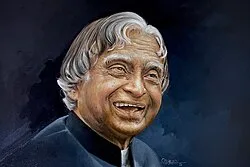
July 27, 2026 marks eleven years since the death of APJ Abdul Kalam, the scientist who helped build India’s first satellite launch vehicle and later its missile program before becoming the country’s 11th President. He died mid-lecture, in front of a room of students, which was fitting for a man who spent much of his later life trying to get young Indians excited about science. In India he is remembered as the Missile Man, and later as the People’s President.
Early life in Rameswaram
Kalam was born Avul Pakir Jainulabdeen Abdul Kalam on October 15, 1931, in Rameswaram, a small pilgrimage town on the Tamil Nadu coast. His father, Jainulabdeen, owned boats that he rented out to local fishermen and served as imam of the town mosque. The family had once been better off, but by the time Kalam was a boy money was tight enough that he sold newspapers after school to help pay for his own education.
He finished school at Schwartz Higher Secondary School in nearby Ramanathapuram, then earned a physics degree from St. Joseph’s College in Tiruchirappalli in 1954. He had wanted to fly fighter jets for the Indian Air Force and came close, finishing ninth in a selection process that only had eight openings. He turned to aerospace engineering instead, studying at the Madras Institute of Technology.
From DRDO to ISRO
Kalam joined the Defence Research and Development Organisation, DRDO, in 1958, and moved to the newly formed Indian Space Research Organisation, ISRO, in 1969. There he became project director of India’s first indigenous satellite launch vehicle, SLV-3, which put the Rohini satellite into orbit in July 1980. The launch made India one of a small handful of countries able to put its own satellites into space, and Kalam’s design choices from that period later shaped ISRO’s PSLV rocket, still in use today.
The missile years
In the early 1980s Kalam returned to DRDO to lead the Integrated Guided Missile Development Programme, which produced the Agni and Prithvi missiles and gave him the nickname that stuck for the rest of his life, the Missile Man of India. He went on to serve as Chief Scientific Adviser to the Prime Minister and Secretary of DRDO through the 1990s, and played a central role in India’s Pokhran-II nuclear tests in May 1998. He received the Padma Bhushan in 1981, the Padma Vibhushan in 1990, and the Bharat Ratna, India’s highest civilian award, in 1997, all before he had held any political office.
President of India
In 2002, Kalam was elected the country’s 11th President with support from both the ruling coalition and the opposition, an unusually broad consensus for the role. He served until 2007 and became known as the People’s President for his plain living and his habit of speaking directly with students and ordinary citizens rather than staying behind protocol. After leaving office he kept teaching and writing, arguing repeatedly that India’s future depended on its young people. His books, including the autobiography Wings of Fire and India 2020: A Vision for the New Millennium, are still widely read in Indian schools.
Death at IIM Shillong
On July 27, 2015, Kalam traveled to Shillong to deliver a lecture called “Creating a Livable Planet Earth” at the Indian Institute of Management. He felt unwell climbing a flight of stairs beforehand but recovered enough to walk into the hall. About five minutes into the talk he collapsed. He was rushed to a nearby hospital, where doctors could not revive him; he had suffered a cardiac arrest at the age of 83. He was given a state funeral three days later and buried in his hometown of Rameswaram, where a memorial to him now stands.
Legacy
His birthday, October 15, is marked in India as World Students’ Day. Roads, research institutions, and even a bacterium and a plant species discovered after his death carry his name. Eleven years on, Kalam is remembered less for any single missile or satellite launch than for making science and public service feel within reach of anyone, an impression he worked at deliberately for most of his life.