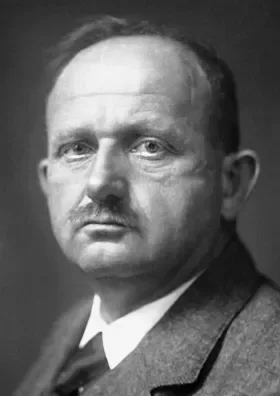
July 27, 2026 marks 145 years since the birth of Hans Fischer, the chemist who worked out the chemical structure of haemin, the iron-containing pigment in blood, and chlorophyll, the pigment that gives leaves their green colour. He proved the two are built on the same underlying framework, and he did it without any of the tools modern chemists take for granted, no X-ray crystallography, no mass spectrometry. Fischer won the 1930 Nobel Prize in Chemistry for the work.
Early life and training
Hans Fischer was born on July 27, 1881, in Höchst, Germany. His father directed a chemical manufacturing company, so the industry was already part of family life before Hans ever picked up a test tube. He studied chemistry and medicine at the same time, first at the University of Lausanne, then at Marburg, where he earned his chemistry degree in 1904. He completed a medical degree in Munich in 1908.
That dual training stayed with him. He carried a doctor’s interest in the substances that keep the body running together with a chemist’s patience for taking those substances apart, piece by piece.
Early in his career he worked as an assistant to the chemist Emil Fischer in Berlin (no relation, despite the shared name). He then held teaching posts in Munich, Innsbruck, and Vienna before returning to Munich in 1921, this time as professor of organic chemistry at the Technical University. He stayed there for the rest of his career.
Working out the structure of haemin
Haemin is the crystalline, iron-containing fragment of hemoglobin that lets blood carry oxygen. Chemists knew it was made of smaller ring structures called pyrroles, but nobody had proven exactly how those rings were arranged. Fischer’s method was simple in concept and brutal in practice: break haemin down into simpler fragments, identify each one, then reconstruct the full molecule from those fragments in the laboratory. In 1929 he succeeded. He synthesized haemin from simple starting materials and confirmed that four pyrrole rings were linked around a single iron atom. Over his career, he and his students carried out more than sixty thousand microanalyses of individual compounds.
The Nobel committee awarded him the 1930 Prize in Chemistry for working out the structure of haemin and chlorophyll, and especially for successfully synthesizing haemin.
Chlorophyll and haemin share a structure
Fischer’s most significant finding was that chlorophyll is built on the same four-ring pyrrole structure as haemin, though the two are not identical. The main difference is the metal at the center: iron in haemin, magnesium in chlorophyll. Even so, the pigment that lets a plant absorb sunlight and the pigment that lets blood carry oxygen turned out to be close chemical relatives, despite coming from completely different kingdoms of life. Fischer never completed a full synthesis of chlorophyll himself, though he came close. Robert Burns Woodward achieved the first full synthesis in 1960, building on the structural work Fischer had done decades earlier.
Fischer also worked out the structures of two bile pigments, biliverdin and bilirubin, responsible for the colors of bruises and jaundice, and synthesized both in the early 1940s.
The war years
Fischer built his laboratory at the Technical University of Munich into one of the most productive chemistry institutes in Europe, with a large staff and a three-volume reference work on pyrrole chemistry to his name. Nazi policies badly disrupted this work. Fischer is documented to have protected Jewish students from persecution, even as members of his own staff were forced to leave the country or died in concentration camps. He kept working through the early 1940s and published his synthesis of bilirubin in 1944.
Late in the war, Allied bombing destroyed his institute in Munich: laboratory, library, and decades of unpublished research on chlorophyll, all gone. Fischer, by most accounts a man who had devoted his life almost entirely to his work, did not recover from the loss. He died by suicide in Munich on March 31, 1945, Easter Sunday. American troops took the city exactly one month later, on April 30. His own mentor, Emil Fischer, had also died by suicide, in 1919, after years of poor health and the loss of two sons in the First World War.
Legacy
Fischer’s system for numbering the carbon atoms in the porphyrin ring is still used in biochemistry textbooks today, and the Fischer-Fink method for building pyrroles still carries his name. In 1976, a crater on the moon was named jointly after Hans Fischer and Emil Fischer. His structural work on porphyrins also laid the groundwork for later achievements, including Woodward’s synthesis of chlorophyll and, decades later, the total synthesis of vitamin B12 by Woodward and Albert Eschenmoser.
A hundred and forty-five years after his birth, Fischer is remembered for showing that two of the most familiar colors in nature, the red of blood and the green of leaves, come from the same basic chemical structure.