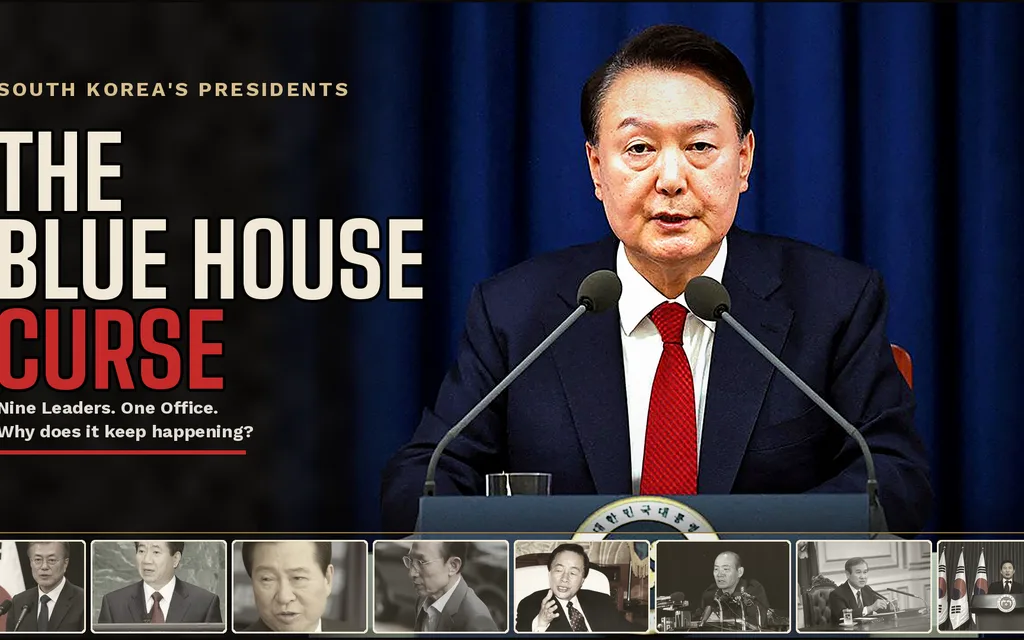
In the summer of 2025, South Korea’s new president spent weeks moving his office back into Cheong Wa Dae — the “Blue House” his predecessor had abandoned for a new complex in Yongsan. It is not a neutral building to move into. Since the country’s 1987 transition from military rule, seven of the eight men who have occupied it as democratically elected presidents have left office to face criminal investigation, prosecution, impeachment, or worse. Lee Jae-myung, the president who moved back in, has said so himself: asked by The Economist whether he expected the same fate, he called it “pretty likely.” Korean commentators have a name for this: the Cheong Wa Dae curse.
This case study takes that pattern as a genuine puzzle rather than a settled verdict. The popular framing — that South Korean presidents are simply persecuted — moves faster than the evidence allows. What follows organizes the inquiry around five specific, competing explanations rather than one predetermined conclusion.
Scope note: this piece concentrates on the constitutional and criminal law of the Republic of Korea. References to Peru and Brazil in Section 5 are comparative and journalistic, not an independent analysis of those countries’ legal codes. Chun Doo-hwan is discussed below as essential precedent but excluded from the eight-president dataset analyzed in Sections 1–4, because his prosecution was transitional justice against a coup leader who ruled before the 1987 constitution — a different phenomenon from a democratically elected president’s post-term exposure.
Background & Context
The precedent: in 1996, Chun Doo-hwan — who seized power in a 1979 coup and ordered the suppression of the Gwangju uprising in 1980 — and his successor Roh Tae-woo were convicted of mutiny, treason, and corruption. Chun was sentenced to death, later commuted to life; Roh received 22.5 years, later reduced to 17. Both were released on December 22, 1997, pardoned by outgoing president Kim Young-sam at the request of president-elect Kim Dae-jung — a man Chun’s own government had once sentenced to death — in the name of national reconciliation. That sequence — severe conviction followed by negotiated release within about two years — became a template political actors would reach for again: harsh judgment, absorbed once the original conflict had cooled.
The eight presidents elected since then divide unevenly. Roh Tae-woo, Lee Myung-bak, Park Geun-hye, and Yoon Suk-yeol were personally convicted or removed by a court. Kim Young-sam and Kim Dae-jung were never personally charged — their sons were, on bribery and tax counts, while the presidents themselves finished their terms uninvestigated. Roh Moo-hyun was under active investigation for family bribery when he died by suicide in 2009, before any judgment was reached against him. Moon Jae-in was indicted in April 2025; as of this writing the case remains in pretrial hearings, with a jury trial recently signaled but not yet begun. The question this case study asks is not whether the pattern is real — it plainly is — but which of five competing explanations for it actually holds up against the record.
| President | Term | Personal legal outcome | Clemency |
|---|---|---|---|
| Chun Doo-hwan* | 1980–1988 | Convicted 1996 — mutiny, treason, corruption; death sentence commuted to life | Pardoned Dec. 1997 |
| Roh Tae-woo | 1988–1993 | Convicted 1996 — same charges; 22.5 years, reduced to 17 | Pardoned Dec. 1997 |
| Kim Young-sam | 1993–1998 | No personal charge; son convicted of bribery and tax evasion | — |
| Kim Dae-jung | 1998–2003 | No personal charge; two sons convicted of bribery | — |
| Roh Moo-hyun | 2003–2008 | Investigated for family bribery; died 2009 before any judgment | — |
| Lee Myung-bak | 2008–2013 | Convicted 2018 — embezzlement, bribery, tax evasion; 17 years | Pardoned Dec. 2022 |
| Park Geun-hye | 2013–2017 | Impeached and removed 2017; convicted 2018 — abuse of power, coercion; 22 years | Pardoned Dec. 2021 |
| Moon Jae-in | 2017–2022 | Indicted Apr. 2025 on bribery; pretrial hearings ongoing, no verdict | — |
| Yoon Suk-yeol | 2022–2024 | Convicted on four separate charges in 2026 — life (insurrection, Feb.); 30 yrs (drone operation, Jun.); 7 yrs (arrest obstruction, upheld on appeal Jul.); suspended term (election law, Jul.); further trials pending | — |
*Pre-1987-transition; shown for context only and excluded from this case study’s eight-president dataset.
1. The Corruption and Accountability Hypothesis
Case Background. The simplest explanation is also the least dramatic: South Korean presidents are prosecuted because South Korean presidents, or their families, commit real crimes, and courts find real evidence of it. On this account the “curse” is not a curse at all — it is the rule of law working as intended, however uncomfortable that looks in aggregate.
Evidence/Mechanism. The record only partly supports the strong version of this claim. Lee Myung-bak was convicted in 2018 and sentenced to 17 years after the Supreme Court found he covertly owned DAS, an auto-parts firm used to channel a 33.9 billion-won slush fund, and that Samsung had paid millions in litigation fees on DAS’s behalf in exchange for a pardon for Samsung’s former chairman. Park Geun-hye was removed by a unanimous eight-justice ruling in Case on Impeachment of President Park Geun-hye, 2016Hun-Na1 (Const. Ct., Mar. 10, 2017), which found she had let her confidante Choi Soon-sil extract tens of millions of dollars from conglomerates while secretly directing state affairs — a finding the Court reached independently of, and before, her separate criminal conviction.
Yoon Suk-yeol’s own record illustrates the strong version of this hypothesis most starkly, and is more extensive than a single conviction implies. Separate courts convicted him on four counts in 2026 alone: life imprisonment for leading the insurrection (February); 30 years for ordering drone flights over Pyongyang two months before declaring martial law (June); seven years — up from an initial five on appeal, and upheld by the Supreme Court in July — for resisting arrest and falsifying the record of the Cabinet meeting that preceded the martial-law decree; and an 18-month suspended sentence for lying about a shaman’s influence on his 2022 campaign. Most of the underlying facts were undisputed at trial: he does not deny declaring martial law, ordering the drone flights, or resisting his own arrest. The dispute in the martial-law-related cases was over lawfulness, not events. His own defense deserves to be stated plainly, since it is the strongest case available to him: he argued that deploying an emergency power the constitution genuinely grants the president was a legitimate, if extreme, “warning signal” to an opposition he considered obstructionist — not a crime. Every court that has heard that argument has rejected it, but rejecting it is not the same as it having been frivolous.
Other cases are weaker on this same test. Prosecutors indicting Moon Jae-in stated they had found no evidence he personally arranged his son-in-law’s employment at Thai Eastar Jet — the bribery theory rests on inference, that the airline’s founder “likely expected his assistance to be repaid” after Moon later appointed him to a state agency. Roh Moo-hyun was never convicted of anything; the $6 million bribery allegation against him, involving a businessman close to his family, was still an active investigation, not a finding, when he died. And two of the eight presidents were never implicated in their own right at all.
Case Finding: Personal judicial findings of criminal or constitutional wrongdoing exist against four of South Korea’s eight democratically elected former presidents — Roh Tae-woo, Lee Myung-bak, Park Geun-hye, and Yoon Suk-yeol. Two more (Kim Young-sam, Kim Dae-jung) were never personally charged; only their sons were convicted. One (Roh Moo-hyun) died under investigation with no judgment reached. One (Moon Jae-in) faces an indictment resting partly on inference, with no verdict yet. The claim that “every” president has been punished is accurate only if a president’s own conviction and his son’s conviction are silently treated as the same thing.
2. The Institutional Concentration Hypothesis
Case Background. A second explanation locates the problem in the office itself: the 1987 constitution built a presidency with vast executive discretion and comparatively little of the appointment and budget oversight that legislatures in other systems exercise, on the theory that a security threat from the North and a state-led industrial strategy both required a strong center.
Evidence/Mechanism. The constitutional text supports a real, if narrower, version of this claim than “near-monopoly.” Article 54(2) gives the government — meaning the executive — sole authority to draft the budget bill; Article 57 then bars the National Assembly, without the executive’s consent, from increasing any expenditure item or creating a new one in that bill. That is a genuine, textually granted asymmetry: the Assembly can cut or reject what the president proposes, but it cannot add to it or redirect it without the president’s sign-off. It is not the same as the Assembly having no role. The Lee administration did reorganize budget authority, proposed in September 2025 and implemented that following January — but not in a way that touches this asymmetry. It split the former Ministry of Economy and Finance into a narrower successor ministry plus a new Ministry of Planning and Budget, and placed the latter under the Prime Minister’s Office rather than spinning it out as an independent body. Since the Prime Minister is nominated and appointed by the president and serves at the president’s pleasure, that reorganization moves budget authority within the executive branch rather than away from it. President Lee’s own stated reason for it was that the old, unified finance ministry had been “acting like a king over other ministries” — a complaint about concentration between cabinet departments, not between the executive and the legislature. Appointment power is broader still: the president names thousands of executive-branch officials, state-enterprise heads, and regulators who answer to the presidential office rather than the legislature.
This concentration is best understood as an opportunity structure rather than a direct cause. Choi Soon-sil held no government position; she was able to extract money from conglomerates and review state secrets only because of her private access to a president operating with minimal institutional friction around her. The DAS slush fund functioned the same way — proximity to unchecked executive discretion, not a specific criminal directive, is what let both scandals grow as large as they did. The same concentration is also what let Yoon invoke the constitution’s emergency-powers provision — designed for genuine national crises — as the legal vehicle for an attempt to sideline the legislature altogether.
Case Finding: The president holds exclusive constitutional authority to initiate and expand the budget (Arts. 54(2), 57) and exclusive appointment power over thousands of posts, while the Assembly retains a real but asymmetric, subtractive-only check. That concentration is a necessary condition for the pattern of scandals built around presidential in-laws, aides, and appointees — Choi Soon-sil, DAS, Thai Eastar Jet — but it does not by itself explain why some of those scandals end in prison and others do not.
3. The Political Polarization Hypothesis
Case Background. A third explanation holds that the underlying facts matter less than who is in power when a case is opened: investigations accelerate against a president once the opposing party controls the prosecution service, turning ordinary political rivalry into legal warfare.
Evidence/Mechanism. The timing evidence is mixed rather than uniform. Roh Moo-hyun’s family was investigated under conservative successor Lee Myung-bak; Lee Myung-bak was himself indicted five years after leaving office, under liberal successor Moon Jae-in — both cases fit a clean opposing-party pattern. Pardons follow a similar but not identical logic: Park Geun-hye, a conservative, was pardoned by liberal Moon Jae-in in December 2021; Lee Myung-bak, also a conservative, was pardoned by conservative Yoon Suk-yeol in December 2022 — one cross-party gesture of reconciliation, one same-party act of protection.
Two of the most significant recent cases complicate the pattern rather than confirm it. Moon Jae-in’s indictment was filed in April 2025 by career prosecutors during the caretaker period between Yoon’s removal and the election that installed Lee Jae-myung — a fellow member of Moon’s own Democratic Party — and the underlying investigation traces back to a private citizen’s complaint filed in December 2021, during Moon’s own final year in office. That sequence does not fit a simple “the other side did it to him” story, though it is worth stating the Democratic Party’s own objection plainly, since it is the strongest version of their case: the party has called the indictment retaliatory regardless, arguing prosecutors stretched an ordinary family employment arrangement into a bribery theory only once it became politically convenient to do so. Yoon Suk-yeol’s prosecutions do fit the opposing-party pattern in one sense — he is a conservative convicted under a liberal successor — but rest on facts, a televised martial-law order and an admitted drone operation, that do not depend on who held office to establish them.
The clearest evidence against a purely partisan reading is institutional rather than electoral: in 2004, the conservative-controlled National Assembly impeached Roh Moo-hyun, a liberal, over campaign-conduct violations — and the Constitutional Court rejected the impeachment as insufficient, reinstating him within two months. The same court that would later remove Park and Yoon also once overruled a legislature trying to remove a president it disliked. And the September 2025 bill to abolish the prosecution service — the single biggest structural response to “weaponization” concerns — passed 174 to 1, with five abstentions, a margin no single party commands alone.
Case Finding: In two of four post-2003 cases (Roh Moo-hyun investigated under a conservative successor; Lee Myung-bak indicted under a liberal one), the opposing-party pattern holds cleanly. Moon Jae-in’s prosecutors answered to his own party’s government by the time of indictment, and Yoon Suk-yeol’s convictions rest on facts — a televised order, an admitted operation — that do not depend on who held office. Polarization measurably shapes which cases move fastest and hardest; it does not manufacture the underlying facts of the strongest ones.
4. The Prosecutorial Design Hypothesis
Case Background. A fourth explanation blames the machinery itself: since 1948, the prosecution service has held both the power to investigate and the power to indict, a dual authority most democracies split between separate bodies. Whoever controls that office can build a case against a predecessor with no other institution positioned to stop them before trial.
Evidence/Mechanism. The clearest illustration is Yoon Suk-yeol’s own career: a career prosecutor who rose to national prominence investigating Park Geun-hye’s network, later led the investigation of Moon Jae-in’s justice minister Cho Kuk as Prosecutor General, and rode that reputation to the presidency in 2022. The dual power was, for one man, a functioning path from investigator to incumbent — evidence that the office’s design creates the incentive this hypothesis describes, independent of any one scandal’s merits.
That design is now being dismantled, on a revised timeline from what earlier accounts suggested. The National Assembly passed the amendment splitting the prosecution service on September 26, 2025, by the 174–1 vote noted above; reporting on the effective date varies between “September 2026” and a specific October 2, 2026, a discrepancy this piece flags rather than resolves. Either way, as of this writing (July 2026) the split has not yet occurred: the prosecution service remains intact and operating. Prosecutor General Shim Woo-jung’s resignation is sometimes misremembered as a protest of the abolition vote — in fact he announced it on July 1, 2025, nearly three months before the abolition bill passed, citing concern that reform pursued “with a set deadline and a predetermined outcome” would produce “unexpected side-effects,” not a protest of a fait accompli that had not yet happened. His resignation followed months of friction with the ruling party over his handling of Yoon’s case, including a Democratic Party impeachment motion against him in May 2025. Separately, reporting from that period documents real concern about a broader departure of prosecutors as the reform proceeded, short of a specific “wave of resignations in protest” of the September vote itself.
The reform’s substance deserves scrutiny on its own terms. It replaces one concentrated office with two: a Public Prosecution Service under the Ministry of Justice, holding indictment power only, and a Serious Crimes Investigation Agency under the Ministry of the Interior and Safety, holding the investigative power that mattered most in every case above. Legal scholars and departing prosecutors have warned that housing serious-crimes investigation inside the Interior Ministry — a cabinet department reporting directly up the presidential chain — may concentrate political control rather than remove it, and that severing investigation from indictment could weaken the state’s capacity to build the kind of complex financial case DAS or Choi Soon-sil required. That is the strongest case for the system it replaces, and it deserves to be weighed against the abuses that same concentration enabled.
Case Finding: A single agency holding both investigative and indictment power over the political elite since 1948 gave prosecutors both the tools and the incentive to build cases against outgoing administrations — visible directly in Yoon Suk-yeol’s own path from special prosecutor to president. The 2025 reform, not yet in effect as of mid-2026, splits those powers between two bodies, but places the larger one under a cabinet ministry more directly answerable to the president than the office it replaces — relocating the political control point rather than removing it.
5. The Comparative Presidentialism Hypothesis
Case Background. The final explanation holds that none of this is specifically Korean: fixed-term presidential systems generally, especially polarized ones, funnel political conflict into courts because they lack a parliamentary system’s release valve — a vote of no confidence and an early election — leaving impeachment or prosecution as the only exit from a paralyzed government.
Evidence/Mechanism. The comparative record does not support treating South Korea as exceptional. Peru’s post-1990 presidents have fared at least as badly, most recently Martín Vizcarra, sentenced to 14 years for bribery in November 2025, and Pedro Castillo, sentenced on November 27, 2025 to 11 years and five months for conspiracy to commit rebellion after his own December 2022 attempt to dissolve Congress by decree — a sentence well below the 34 years prosecutors sought, reached by a split 2–1 panel vote. Brazil’s Jair Bolsonaro was convicted on September 11, 2025 and sentenced to more than 27 years for plotting to stay in power after his 2022 election defeat, by a divided 4–1 panel whose ruling drew formal objection from the U.S. government — a reminder that even well-evidenced cases generate real, live political controversy about their fairness, not manufactured controversy.
The most direct evidence on this hypothesis is academic rather than journalistic. Ginsburg, Huq, and Landau’s peer-reviewed comparative study of presidential impeachment — which draws explicitly on South Korea as one of four core case studies, alongside Paraguay, Brazil, and South Africa — finds that impeachment functions less as a tool for removing “bad actors” than as a systemic release valve for exiting political crises that would otherwise fester, and that its more frequent use in these systems shows no measurable negative effect on democratic quality. That finding sits uneasily with framing the Korean pattern as a unique institutional pathology; it fits far better with the polarized-presidentialism explanation this section tests.
Case Finding: Peru’s and Brazil’s post-1990 presidents have faced criminal jeopardy at a rate matching or exceeding South Korea’s, and the leading peer-reviewed comparative study of presidential impeachment — using South Korea as one of its core cases — finds no measurable damage to democratic quality from its frequent use. The claim that South Korea is uniquely or exceptionally punitive toward former leaders is not supported by the comparative record.
Cross-Cutting Analysis
None of these five explanations stands alone, and the more useful finding is how directly they feed each other. Institutional concentration (Section 2) is the shared root of both the genuine corruption opportunities that produce real convictions (Section 1) and the concentrated prosecutorial power capable of pursuing them (Section 4) — the same constitutional design that let Choi Soon-sil operate unchecked also gave prosecutors the unchecked dual authority to eventually expose her. Polarization (Section 3) does not create these cases from nothing; it determines which scandals get investigated fastest, prosecuted hardest, and pardoned soonest, layering political timing on top of facts that, in the strongest cases, would likely have surfaced regardless. And the comparative frame (Section 5) suggests the deep variable underneath all of this is not anything specifically Korean but the single fixed presidential term itself: Article 70 bars re-election entirely, guaranteeing that every administration eventually enters a lame-duck period with no further electoral accountability to answer to, and no parliamentary vote of no confidence available to resolve a crisis short of prosecution or impeachment. Peru and Brazil share that same structural feature and show the same pattern. A parliamentary system routes comparable political pressure through a no-confidence vote and a new election; South Korea’s constitution, like Peru’s and Brazil’s, routes it through a courtroom.
This also suggests why the 2025–26 prosecutorial reform is unlikely to resolve the underlying pattern even if it proceeds on schedule. It changes which office investigates a former president. It does not change whether a single-term system will keep producing lame-duck presidents whose successors — of either party — have both the opportunity and, in the genuinely corrupt cases, the obligation to investigate them.
Conclusion
The strongest available answer to why South Korea’s presidency ends this way is not any one explanation above but a specific combination: a constitutionally concentrated office, operating on a fixed single term that guarantees eventual lame-duck exposure, investigated by a historically unchecked prosecutorial apparatus, under conditions of polarization severe enough to determine timing and intensity — applied to a set of cases where courts reached and upheld findings of real, specific misconduct exactly half the time (four of eight presidents), where two more presidents were never personally implicated at all, and where the remaining two cases were cut short by death and by a trial still underway. That is a less satisfying story than either “South Korea persecutes its leaders” or “South Korea simply holds them accountable.” It is also the one the evidence actually supports.
President Lee Jae-myung’s own acknowledgment that he could face the same fate is itself data, not just color: it suggests the pattern is understood, even by its current beneficiary, as structural rather than a matter of any one leader’s individual vice or virtue. Whether Lee becomes the ninth name added to this record, and under what mix of the five explanations above, is a question this case study cannot yet answer — nor could any piece written from inside his own term. That may be the most honest place to leave it.
Policy Recommendations
-
An evidentiary gate for post-term investigations of predecessors. A requirement — a supermajority referral, cross-party sign-off, or an independent preliminary-review panel — before a new administration’s prosecutors may open a formal investigation into an immediate predecessor would filter cases with a specific evidentiary basis (DAS, Choi Soon-sil) from those resting substantially on inference (the theory underlying the Moon indictment), without blocking legitimate accountability.
-
Move budget authority genuinely outside the executive branch. The Lee administration’s January 2026 reorganization split budget authority into a new Ministry of Planning and Budget — but kept it inside the executive, under the Prime Minister’s Office, whose head serves at the president’s pleasure. A body that actually addressed Section 2’s concentration finding would need independence from the presidency itself, closer to the model of the National Assembly’s own budget office, rather than a relocation within the cabinet.
-
Statutory insulation for the Serious Crimes Investigation Agency. Given that the SCIA will sit inside the Ministry of the Interior, a fixed, removal-protected term for its director would blunt the concern, raised in Section 4, that the reform relocates political control rather than ending it.
-
A published-reasoning requirement for presidential pardons. The Chun–Roh Tae-woo, Park, and Lee Myung-bak pardons all followed the same undocumented “national reconciliation” logic. Requiring a public, written justification tied to specific criteria would not end the practice of clemency, but would make it harder to use as a routine mechanism for absorbing the very convictions the system just secured.
-
A longer-term conversation about the single term itself. This is the most structurally significant lever this case study identifies, and the hardest to act on. Any change to Article 70’s non-renewable five-year term would require constitutional amendment and carries its own risk — a renewable term reintroduces the incumbency-entrenchment concerns the 1987 drafters were specifically trying to foreclose. It belongs on the table as a subject of sustained debate, not as a proposal this case study can responsibly resolve on its own.
Corrections: factual challenges regarding this piece can be sent to the editor at editor@faultlineglobal.com
Sources
Primary & academic: Constitution of the Republic of Korea, official translation (Korea Law Translation Center) · Ginsburg, Huq & Landau, “The Comparative Constitutional Law of Presidential Impeachment” (University of Chicago Law Review) · Yale Journal of International Law on the Park Geun-hye ruling · East Asia Forum / ANU on Roh Moo-hyun’s 2004 impeachment · U.S.-Asia Law Institute on prosecutorial reform · International Center for Transitional Justice on Peru and Brazil
News coverage: Reuters, AP, CNN, NPR, The Washington Post, Al Jazeera, CBS News, The Korea Herald, The Korea Times, and Korea JoongAng Daily.